
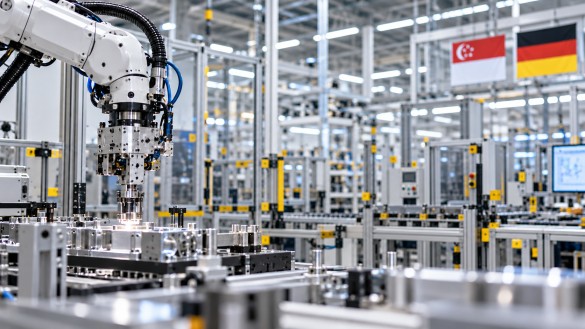
Singapore and Germany have committed to enhancing their collaborative efforts in artificial intelligence (AI), industrial technology, research, and innovation, marking a significant step in their strategic partnership. This development comes after a meeting between Singapore’s Prime Minister Lawrence Wong and Germany’s Chancellor Friedrich Merz on October 27, where they updated their cooperation roadmap.
The updated plan builds on a 2024 initiative and focuses on integrating industrial AI, boosting the digital economy, advancing manufacturing, and exploring emerging technologies. Both leaders emphasized the transformative potential of AI in boosting productivity and creating new business opportunities within industries.
The collaboration aims to expand the application of industrial AI across manufacturing, robotics, logistics, and other sectors. Additionally, both nations intend to ensure AI is deployed responsibly, focusing on safety and security to maintain trust and a human-centered approach.
Research partnerships are set to broaden during the Singapore-Germany Year of Innovation, with joint projects anticipated in fields like artificial intelligence, semiconductors, quantum technology, space, green technologies, and advanced manufacturing. Existing academic and research partnerships will be leveraged to accelerate innovation and technological growth.
Furthermore, Singapore and Germany plan to fortify economic ties between the Association of Southeast Asian Nations (ASEAN) and the European Union. Singapore intends to collaborate with Germany during its 2027 ASEAN chairmanship to further regional cooperation, including efforts towards an ASEAN-EU free trade agreement and digital integration.
The discussions also covered regional energy connectivity and the protection of critical underwater infrastructure like subsea cables and pipelines. Germany’s support for Singapore’s initiative on underwater infrastructure protection underscores a shared commitment to international law, multilateral cooperation, and a rules-based global order.