
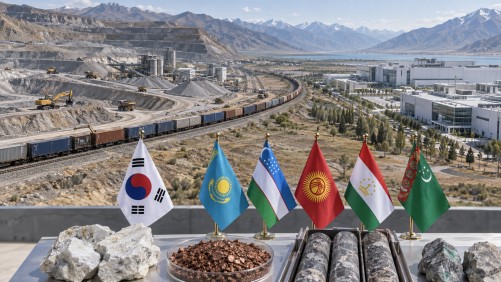
The expansion of South Korea’s cooperation with Central Asian nations on critical minerals is set to significantly impact industries such as automotive, electronics, battery, and energy. This collaboration aims to secure reliable mineral supplies for South Korea, while enabling Central Asian countries to enhance their local processing capabilities and diversify beyond exporting raw materials.
This development follows the first-ever South Korea–Central Asia summit held in Seoul, where more than 70 agreements and memorandums were signed. The summit, which will now occur biennially, also saw the establishment of a C5+1 forum for industry ministers, underscoring the priority placed on critical minerals within this new cooperative framework.
South Korea has proposed a strategic alliance that would merge Central Asia’s rich mineral resources with its own expertise in exploration, processing, and advanced manufacturing. The scope of cooperation includes the entire supply chain, from identifying mineral deposits and mining to processing and producing high-value products. Plans are underway to set up rare metals research and training centers in the region to support these efforts.
Among the Central Asian countries, Uzbekistan has suggested forming an investment alliance focused on critical minerals, with an eye on establishing processing clusters covering exploration, mining, and production. Kazakhstan has offered to collaborate on rare metals, nuclear and clean energy, artificial intelligence, and infrastructure, while also strengthening its strategic partnership with South Korea. Meanwhile, Kyrgyzstan and Tajikistan are seeking South Korean expertise in mining minerals such as antimony and tungsten.
This initiative comes at a time when global powers like China, the United States, the European Union, and Japan are also vying for access to Central Asia’s critical mineral resources. The region’s governments are increasingly keen on attracting investments that foster local processing and industrial production rather than merely exporting raw materials. The next South Korea–Central Asia summit is slated for 2028 in Kazakhstan, promising further advancements in this burgeoning partnership.